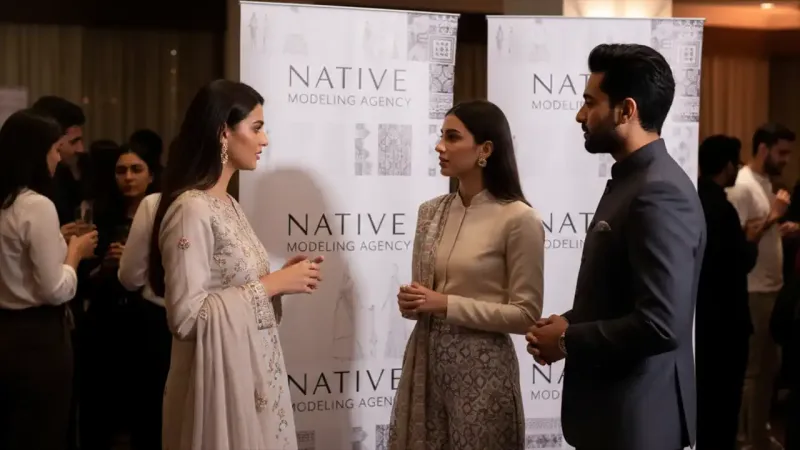
What the Fine Print Won't Tell You: How Islamabad's Models Are Outmaneuvering Western Contracts

There is a version of a modeling career that looks successful on the surface—campaign credits, international bookings, a growing social following—and yet leaves the professional who built it with remarkably little to show for it financially. For years, models from markets outside New York, Los Angeles, and Milan were expected to accept standard boilerplate contracts without question, largely because they lacked the institutional knowledge to push back. That era is ending, and Islamabad's talent community is playing a significant role in bringing it to a close.
Models operating out of Islamabad are increasingly approaching contract negotiations not as administrative formalities but as strategic conversations. The difference in outcomes between these two postures is considerable.
The Usage Rights Conversation Nobody Initiates for You
When a US brand books a model for a campaign, the initial offer typically includes a day rate and a general usage clause. What that clause actually permits—and for how long—is where the real value either accumulates or evaporates.
Usage rights govern where an image can appear: print, digital, billboard, social media, broadcast, point-of-sale displays, and so on. They also define the geographic territory and the duration of that permission. A campaign image licensed for North American digital use for six months is a fundamentally different asset than one licensed globally across all media for two years. The compensation attached to each scenario should reflect that difference substantially.
Islamabad-based professionals who have worked with Western brands report that usage terms are rarely explained in full during initial negotiations. The model is presented with a contract, a rate, and a timeline. What is not presented is a breakdown of how extensively the brand intends to deploy that imagery—or what the industry standard for compensation looks like when that deployment is broad.
The corrective strategy is straightforward: before signing anything, request a complete usage brief. Ask specifically about media channels, geographic scope, campaign duration, and any option periods the brand may wish to exercise. Once that information is on the table, the rate conversation can proceed from an informed position.
Residual Payments and Why They Rarely Come Up Unprompted
Residual payments—compensation triggered by extended or expanded use of campaign imagery beyond the originally contracted terms—exist in standard industry practice but are seldom volunteered as a discussion point by agencies representing the brand's interests rather than yours.
The logic is not difficult to follow. An agency retained by a US label is working to secure talent at the most favorable terms for that label. Unless your own representation is equally sophisticated, or unless you are negotiating directly with full awareness of what to ask for, residuals will likely not appear in your initial offer.
Models in Islamabad who have navigated multiple Western engagements suggest building residual triggers into contracts as a standard practice rather than an exception. This means establishing clear language around what constitutes extended use, at what threshold a usage renewal fee applies, and how that fee is calculated. Tying residual rates to a percentage of the original usage fee—rather than leaving them as a vaguely defined renegotiation point—provides enforceable clarity.
For campaigns with significant visibility potential, such as those tied to product launches or seasonal retail pushes with large US distribution networks, residual provisions can meaningfully increase the total value of a single booking over its lifetime.
Exclusivity Clauses: The Quiet Career Limiters
Exclusivity provisions are among the most consequential elements of any modeling contract, and they are frequently written in language broad enough to restrict a professional's ability to work with competing brands across entire product categories for extended periods.
A cosmetics campaign, for example, might include an exclusivity clause that prevents the model from appearing in any other beauty-adjacent advertising for twelve months. Depending on how "beauty-adjacent" is defined in the contract language, this could effectively close off a substantial portion of available bookings during that window.
Islamabad's more experienced professionals have developed a practice of narrowing exclusivity language as aggressively as possible during negotiation. This includes limiting the category definition to the specific product type being advertised, restricting the exclusivity period to the active campaign window rather than an extended buffer, and negotiating a separate exclusivity fee when broader restrictions are genuinely required by the brand.
US agencies do not always flag how expansive their standard exclusivity language is. Reading it carefully—or engaging a contract attorney familiar with talent agreements—before any signature is placed is not excessive caution. It is standard professional practice.
Building Long-Term Partnership Terms Into the Initial Agreement
One of the more sophisticated strategies emerging from Islamabad's professional modeling community involves structuring initial contracts to include provisions for long-term partnership continuation. Rather than treating each booking as a discrete transaction, these professionals are negotiating terms that give them preferential consideration—and defined compensation floors—for future campaigns with the same brand.
This approach serves both parties. Brands benefit from the consistency of working with talent they have already vetted and whose image aligns with their visual identity. Models benefit from reduced booking uncertainty and the ability to plan financially across multiple seasons rather than project to project.
Key elements of a long-term partnership clause include: a right of first refusal for subsequent campaigns within a defined category or timeframe, a rate escalation structure tied to usage performance or campaign success metrics, and clearly defined exit terms should either party choose not to renew.
Negotiating these terms upfront requires confidence and preparation, but the professionals in Islamabad who have done so consistently describe the outcomes as transformative for their careers.
Image Licensing as an Independent Revenue Stream
Beyond campaign-specific usage, there is an often-overlooked opportunity in licensing imagery independently of the brand that originally commissioned it—particularly for editorial work and portfolio content that the model retains rights to.
Understanding the distinction between work-for-hire arrangements, where all image rights transfer to the commissioning party, and standard editorial bookings, where rights may remain shared or negotiable, is foundational. Models who treat every shoot as a potential asset rather than simply a credit are positioning themselves to monetize their visual identity in ways that extend well beyond the original engagement.
Islamabad's talent is increasingly sophisticated about this distinction, and it is contributing to a broader shift in how professionals from this market are perceived by US brands. They arrive at the table prepared. They ask informed questions. And they leave with agreements that reflect the actual value of what they are providing.
The Knowledge Gap Is the Leverage Gap
The negotiation advantage that Islamabad's modeling professionals are building is not rooted in confrontation or adversarial positioning. It is rooted in preparation. The gap between a model who accepts the first offer and one who understands what to ask for is, in most cases, simply an information gap.
Western agencies are staffed by professionals whose institutional interests are not always aligned with yours. That is not a criticism—it is a structural reality of the industry. Closing that knowledge gap, through mentorship, legal counsel, industry resources, and peer networks, is how Islamabad's talent is converting international bookings into durable, financially meaningful careers.
The contract is not the finish line. It is the starting point. And the professionals who understand that distinction are the ones building careers worth talking about.