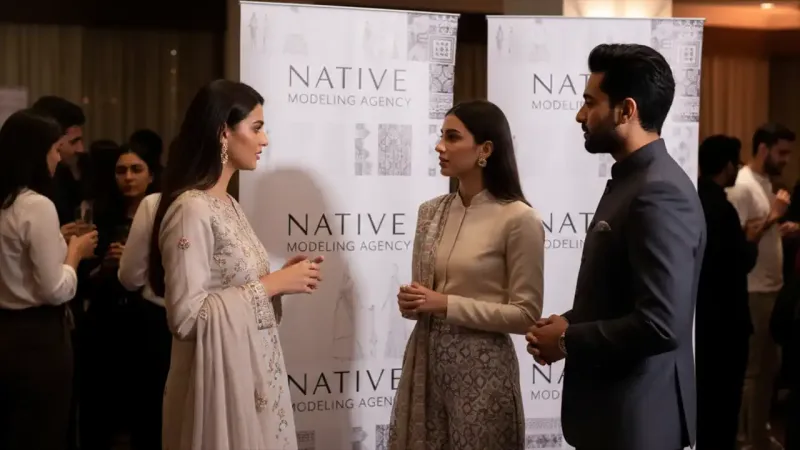
Before They Sign: How Islamabad's Models Are Holding Western Brands Accountable on Their Own Terms

For most of fashion's modern history, the power dynamic between talent and brand has been understood as fixed. Brands extend offers; models accept or decline based on rate and exposure. That calculus is changing in Islamabad, where a rising cohort of professional models is introducing an entirely different variable into the negotiation: ethics.
These are not casual inquiries. The due diligence process that Islamabad's top talent professionals are now conducting before accepting contracts rivals what some boutique investment firms do before committing capital. It is methodical, documented, and increasingly non-negotiable.
The Questions That Are Reshaping Negotiations
The process typically begins well before any formal contract is exchanged. Models and their representatives are presenting prospective brand partners with structured questionnaires that probe areas most Western companies once assumed would never come up in a talent conversation.
Specific inquiries focus on tier-one and tier-two supplier relationships — meaning not just where a garment is assembled, but where its raw materials originate and under what labor conditions. Questions about carbon offset programs, water usage in production, and third-party environmental certifications are now standard components of the intake process for several of Islamabad's most sought-after faces.
One area receiving particular scrutiny is a brand's treatment of workers in South and Southeast Asian manufacturing facilities. For Islamabad-based talent, this is not an abstract concern. Many models have personal or familial connections to communities affected by garment industry labor practices, and they are unwilling to lend their image to companies whose conduct they view as exploitative in their own region of the world.
Why This Shift Is Happening Now
Several forces have converged to make this moment possible. First, Islamabad's modeling talent has accumulated enough market leverage that brands competing for their participation can no longer dictate terms unilaterally. As international fashion houses and American lifestyle labels have expanded their efforts to source authentic South Asian representation, the pool of credible, professionally trained talent in Islamabad has become genuinely competitive to access.
Second, the global sustainability conversation has matured to the point where consumers in the United States and Western Europe are actively scrutinizing the faces that appear in brand campaigns. A model associated with a company later exposed for greenwashing or labor violations faces reputational damage that can take years to repair. Islamabad's talent community has observed these dynamics closely and drawn practical conclusions.
Third, the proliferation of transparency tools — from supply chain tracking platforms to publicly accessible corporate sustainability reports — has made independent verification far more feasible than it was even five years ago. Models no longer have to take a brand's word for its commitments. They can check.
The Due Diligence Infrastructure
What makes Islamabad's approach distinctive is that it has moved beyond individual instinct into something resembling a formalized professional practice. Several talent managers operating in the market have developed internal frameworks for evaluating brand partners that their clients can apply consistently across opportunities.
These frameworks typically assess brands across three primary dimensions. Environmental accountability covers questions about carbon emissions targets, packaging materials, and membership in recognized sustainability coalitions such as the Sustainable Apparel Coalition or the Fashion Pact. Labor practice evaluation examines audit histories, living wage commitments, and whether the brand has responded publicly to any documented violations in its supply chain. Representation integrity — a category unique to the talent side of the equation — assesses whether a brand's broader marketing reflects genuine inclusion or whether diverse talent is being used selectively for campaigns while internal leadership and creative direction remain homogeneous.
Brands that cannot provide satisfactory documentation across these dimensions are increasingly receiving polite but firm declinations from talent that, not long ago, they would have assumed was eager for the work.
How Western Brands Are Responding
The response from American and European fashion companies has been varied. Some have engaged constructively, treating Islamabad's talent community as an unexpected but useful accountability partner. Representatives from several mid-size American lifestyle brands have acknowledged that inquiries from Islamabad-based models prompted internal reviews that surfaced supply chain issues the brands themselves had not fully examined.
Others have pushed back, expressing frustration that what they characterize as standard influencer or model contracts are being subjected to what feels, from their perspective, like a corporate procurement process. This friction has, in some cases, led brands to withdraw from negotiations entirely — an outcome that Islamabad's talent community largely views as clarifying rather than damaging.
The brands that have adapted most successfully tend to share a common characteristic: they arrived at the table having already done serious sustainability work and were therefore able to respond to detailed questions with detailed answers. For those companies, engagement with Islamabad's vetting process has functioned as a kind of third-party validation, strengthening their credibility with talent and, by extension, with the consumers those talent professionals ultimately reach.
The Broader Market Signal
What is unfolding in Islamabad carries implications that extend well beyond any individual contract negotiation. The fashion industry in the United States has spent the better part of a decade contending with consumer-driven demands for transparency. Regulatory pressure from the Securities and Exchange Commission around climate disclosure and proposed supply chain legislation in multiple states has added institutional weight to those demands.
The emergence of a talent community that applies its own independent standards before agreeing to brand partnerships introduces accountability pressure from a direction the industry did not fully anticipate. Models have always influenced culture. The models coming out of Islamabad are now influencing conduct.
For aspiring talent in Islamabad considering how to position themselves in an increasingly competitive international market, this trend offers a practical lesson: professional credibility is no longer built on availability alone. The capacity to evaluate opportunities rigorously — and to decline those that do not meet defined standards — is itself a form of market distinction. It signals to premium brand partners that they are engaging with a professional who understands the full value of what they are offering.
Islamabad's models are not simply faces available for hire. They are professionals with standards, and the international fashion industry is beginning to take that distinction seriously.