Teaching What You Know: How Islamabad's Established Models Are Building Coaching Empires and Strengthening the Talent Pipeline
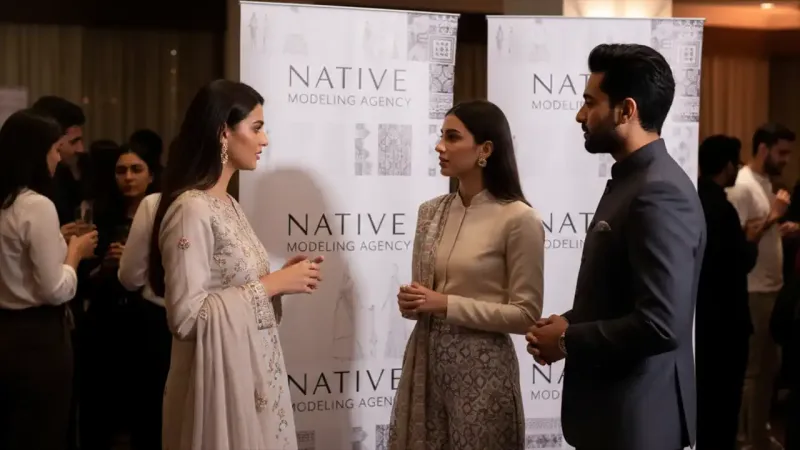
Photo: professional woman mentor coaching younger model fashion studio Islamabad Pakistan, via nativemodeling.com
There is a moment in every successful model's career when the question shifts from how do I break in to what do I do with everything I have learned. In Islamabad, a growing number of established talents are answering that question in a way that is simultaneously entrepreneurial and community-minded: they are building coaching businesses, and those businesses are changing the shape of the local industry.
The phenomenon is not unique to fashion. Across the American economy, the creator economy model — in which individuals monetize expertise directly, without institutional intermediaries — has disrupted fields ranging from personal finance to culinary arts. What is notable about its emergence in Islamabad's modeling scene is the speed of adoption and the sophistication of the structures being built.
The Knowledge Gap That Created the Opportunity
To understand why mentorship programs have taken hold so quickly in Islamabad, it helps to understand what was missing before them.
Traditional modeling agencies in most markets serve two functions: they connect talent with clients, and they prepare talent for the professional environment. In Islamabad, the agency infrastructure has historically been thinner than in cities like Karachi or Lahore, which means that aspiring models entering the market often did so without access to the kind of structured guidance that their peers in more established markets received as a matter of course.
The knowledge gap was real and consequential. A model who did not know how to negotiate a licensing agreement, how to prepare a portfolio that would read well to international clients, or how to manage the tax and business registration dimensions of a freelance career was at a significant disadvantage — regardless of how compelling her look or how strong her work ethic.
Established models who had navigated these challenges through trial and error possessed something genuinely valuable: a practical education that could not be found in any textbook and was not being offered by any institution. The question was whether there was a market for it.
The answer, it turns out, was yes — and the market has proven larger than most anticipated.
From Informal Advice to Structured Programs
The early iterations of this mentorship economy were informal. Experienced models answered questions from younger talents over coffee, reviewed portfolios as a favor, offered feedback on test shoots. The exchange was generous but unsystematic, and the knowledge transfer was incomplete.
What has changed over the past several years is the degree of intentionality. Several Islamabad-based models have moved from informal advising to structured programs with defined curricula, application processes, cohort structures, and pricing tiers.
One model who has been working professionally for nearly a decade launched a twelve-week coaching program that covers portfolio development, client communication, rate negotiation, digital brand building, and the legal basics of freelance contracting. The program runs entirely online, which means participants from across Pakistan can enroll — and a growing number of diaspora-connected aspiring models based in the United States have also signed up, drawn by the combination of professional instruction and cultural specificity.
"I spent years figuring things out the hard way," she explains. "Every mistake I made is now a lesson in the curriculum. I am not just teaching models how to pose — I am teaching them how to run a business. Those are very different things, and the second one is what actually determines whether you have a career."
The Economics of Mentorship
The financial logic of these programs is straightforward but worth examining carefully, because it differs meaningfully from the economics of traditional agency relationships.
A conventional agency earns its revenue by taking a percentage of a model's bookings — typically between fifteen and twenty-five percent, depending on the market and the nature of the work. The agency's incentive is therefore aligned with the model's active earning period. Once a model's booking rate declines, the economic relationship diminishes accordingly.
A coaching or education business operates on a completely different model. Revenue is generated by teaching rather than booking, which means it can scale independently of the mentor's own career trajectory. A model who builds a coaching program with forty enrolled students per cohort and runs three cohorts per year is generating income that is entirely decoupled from whether she personally books any work that month.
For models who have reached the mid-to-late stages of their careers, this decoupling is enormously valuable. It provides financial stability that the inherently volatile nature of modeling rarely offers on its own.
Beyond the primary program revenue, several Islamabad models have built adjacent income streams including one-on-one consulting sessions, portfolio review services, digital courses sold on platforms like Gumroad and Teachable, and affiliate relationships with photographers, makeup artists, and production studios they recommend to their students.
"I think of it as a portfolio of income sources," says one model who has been running a mentorship program for three years. "Some months the bookings are strong. Some months the coaching revenue carries me. Having both means I am never in the position of taking work I do not want just because I need the money."
Building the Ecosystem, Not Just the Business
What distinguishes the most successful of these programs from simple commercial ventures is their explicit commitment to elevating the broader Islamabad talent market.
The logic here is not purely altruistic — it is also strategic. A mentor whose students go on to book international campaigns builds a reputation that attracts higher-quality applicants to future cohorts. The success of the students becomes marketing for the program, which in turn attracts better students, which produces more successful alumni. The cycle is self-reinforcing.
But the community-building dimension extends beyond marketing. Several Islamabad mentors have created alumni networks that function as informal professional associations — spaces where working models share leads, warn each other about problematic clients, collaborate on test shoots, and provide references for one another. This kind of infrastructure, common in established fashion markets like New York and Los Angeles, has historically been absent in Islamabad.
Its emergence through mentorship networks rather than formal institutions is consistent with how the creator economy has developed in other sectors: organically, driven by individuals who identified a gap and built something to fill it.
What Aspiring Models Should Know
For models in Islamabad who are considering either enrolling in a mentorship program or eventually building one of their own, several principles emerge from observing the programs that have succeeded.
First, specificity matters. The coaching programs that command the highest fees and attract the most serious applicants are those with clearly defined outcomes — not general confidence-building or vague industry exposure, but concrete skills like portfolio construction for international clients or rate negotiation for digital campaigns.
Second, the mentor's own track record is the primary credential. Unlike academic institutions, which can confer legitimacy through accreditation, coaching programs in this space live or die by the demonstrated success of the person teaching. A mentor whose own career includes documented international bookings, published editorial work, or verified brand partnerships has a story that sells.
Third, and perhaps most importantly, the most valuable programs are those that treat students as future peers rather than dependents. The goal is not to create loyalty to the mentor — it is to produce professionals capable of contributing to and eventually teaching the next generation. That orientation, more than any curriculum design, is what determines whether a mentorship program becomes a genuine institution or simply a transaction.