Budget Reallocation at the Top: How American Luxury Houses Are Quietly Moving Campaign Dollars From Paris to Islamabad
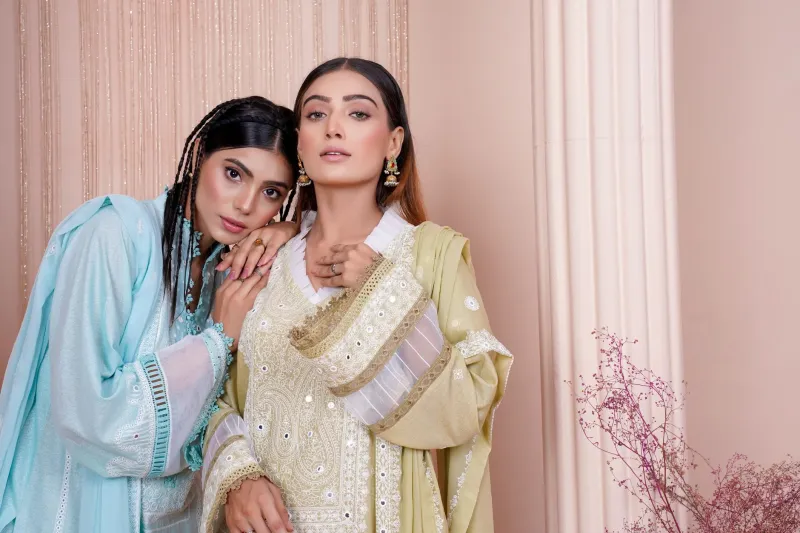
For decades, the calculus was simple. If an American luxury brand wanted to produce a campaign that communicated prestige, it booked a studio in Paris, flew in talent from New York or Milan, and spent accordingly. The invoices were staggering. The results were often indistinguishable from one label to the next. And yet the ritual continued — because European fashion capitals carried a kind of gravitational authority that few marketing directors felt empowered to challenge.
That authority is eroding. Quietly, methodically, and with growing confidence, a cohort of major American luxury houses is redirecting meaningful portions of their international campaign budgets toward a city that, until recently, barely registered on the global fashion radar: Islamabad.
The shift is not accidental. It is the product of careful financial analysis, evolving consumer expectations, and a talent pool that has matured faster than most industry observers anticipated.
The Numbers That Started the Conversation
The reallocation did not begin with a creative revelation. It began with a spreadsheet.
Several brand executives, speaking on background, described a similar sequence of events. A junior strategist or a forward-thinking creative director raised the question of whether European production hubs were still delivering proportionate returns. The numbers were pulled. The comparisons were uncomfortable.
A full-scale campaign production in Paris — encompassing studio rental, local crew, talent fees, post-production, and logistics — routinely runs between $800,000 and $1.4 million for a mid-tier luxury label. The same production scope, executed in Islamabad with locally sourced crew and talent, has come in at figures ranging from $180,000 to $340,000, according to production coordinators familiar with both markets.
That is not a marginal difference. That is a structural one.
"When you show those numbers to a CFO, the conversation changes very quickly," said one creative production consultant who has facilitated campaigns in both markets. "The question stops being 'why would we go to Islamabad?' and starts being 'why haven't we gone sooner?'"
What Islamabad Offers That Paris No Longer Can
Cost alone rarely drives decisions at the luxury tier. Brands in this segment are acutely sensitive to the perception risk of appearing to cut corners. What has made Islamabad compelling is not simply that it is cheaper — it is that it is cheaper without being lesser.
The city's modeling talent has undergone a period of remarkable professional development. Agencies operating in the Islamabad market have invested heavily in international training standards, runway coaching, and editorial preparation. The result is a cohort of models who arrive on set with the technical proficiency that Western creative directors expect, combined with a visual distinctiveness that European talent pools have struggled to replicate.
"There is a specificity to the look and the presence that Islamabad's models bring," noted a casting consultant who has worked with three American luxury labels on Pakistan-based productions. "Global consumers are fatigued by homogeneity. When a campaign features talent that genuinely looks and carries itself differently, it registers. It stops the scroll."
Beyond talent, the city's production infrastructure has matured considerably. Islamabad's landscape — characterized by the Margalla Hills, modernist civic architecture, and a built environment that blends South Asian tradition with contemporary design — offers visual environments that no European capital can provide. For brands communicating heritage, craftsmanship, or a global sensibility, these backdrops carry narrative weight that rented Parisian studios simply cannot manufacture.
Case Studies: Campaigns That Changed the Internal Debate
Several concrete examples have circulated within American fashion marketing circles, accelerating the internal conversations at brands that had previously been reluctant to experiment.
One American accessories label, known for its leather goods and a customer base concentrated in the Northeast and West Coast, piloted a digital campaign in Islamabad with a budget approximately 60 percent lower than its previous European equivalent. The campaign, featuring three Islamabad-based models against a combination of natural and architectural settings, generated engagement metrics that outperformed its Paris predecessor by a margin the brand's digital team described as "significant enough to present to leadership."
A separate American ready-to-wear label with luxury positioning ran a parallel test, producing two versions of a campaign — one in Paris, one in Islamabad — and measured performance across identical audience segments. The Islamabad version, according to a brand-side source, achieved a higher click-through rate and a lower cost per acquisition, while also generating organic media coverage that the Paris version did not.
Neither brand has publicly disclosed these internal findings. But both have since expanded their Islamabad production budgets.
The Cultural Argument That Reinforces the Financial One
The financial case is compelling on its own terms. But brand strategists who have spent time in Islamabad consistently describe a secondary argument — one that is harder to quantify but increasingly difficult to dismiss.
American luxury consumers, particularly those under 45, are demonstrating a measurable preference for brands that reflect a genuinely global perspective. Campaigns that feature talent exclusively from Western European markets are increasingly read as narrow — not aspirational, but limited. Islamabad-based talent introduces a cultural dimension that resonates with a consumer base that is itself more diverse than it was a generation ago.
"Luxury has always been about aspiration," said one brand strategist who consults for multiple American fashion labels. "But the definition of what is aspirational is changing. A campaign that shows the world as it actually is — complex, varied, and not confined to one continent — speaks to consumers who feel invisible in traditional luxury imagery. That is not a small market."
What the Reallocation Means for Islamabad's Fashion Ecosystem
The consequences of this budget shift extend well beyond individual campaign ROI figures. For Islamabad's modeling and production community, the sustained interest of American luxury brands represents a structural opportunity — one that is reshaping career trajectories, training standards, and professional expectations across the industry.
Agencies in the city are reporting increased inquiry volume from international casting directors. Models who might previously have looked exclusively toward Karachi or Dubai for career advancement are finding that international opportunities are arriving in their home market. Production companies are upgrading equipment, expanding crews, and formalizing processes to meet the standards that global clients require.
The talent pipeline, in other words, is not merely responding to demand. It is being strengthened by it.
The Shift Is Still Early — But the Trajectory Is Clear
It would be premature to declare that Paris has been displaced. European fashion capitals retain enormous cultural authority, deep institutional infrastructure, and relationships with luxury brands that span generations. The reallocation currently underway is not a wholesale departure — it is a diversification.
But diversification, in the marketing budgets of major American luxury houses, is rarely reversed. When a market demonstrates that it can deliver equivalent or superior creative output at a fraction of the cost, and when that output resonates with the consumers brands most want to reach, the budget tends to follow.
Islamabad is delivering on both counts. The question facing American luxury brands is no longer whether Pakistan's capital belongs in their production strategy. It is how quickly they are willing to move — and how much of a competitive advantage they are prepared to cede to the labels that moved first.